
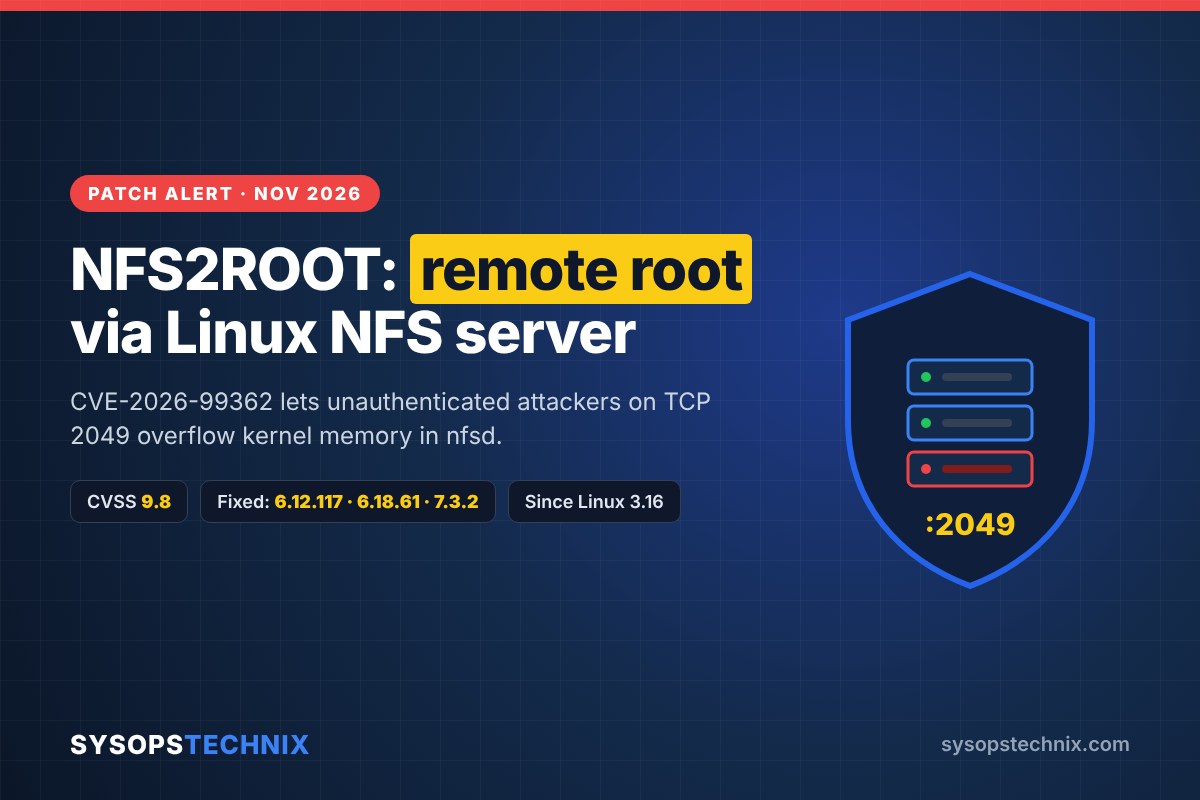
NFS2ROOT is a critical Linux kernel vulnerability in the in-kernel NFS server (nfsd) that lets anyone who can reach TCP port 2049 corrupt kernel memory without logging in, and researchers have already turned it into a root shell. It is tracked as CVE-2026-99362, carries a CVSS 3.1 score of 9.8, and the buggy code has been in every mainline kernel since Linux 3.16, which shipped in 2014.
If you run Linux file servers, NAS boxes, build farms or storage nodes that export NFSv4.1 or 4.2, this one belongs at the top of your patch list. Fixed kernels are out upstream and Debian and Red Hat have started shipping updates, but other distributions were still catching up at the time of writing. Below: what the bug is, a quick way to tell whether you’re exposed, and how to patch or fence off port 2049 until you can.
| CVE ID | CVE-2026-99362 (nicknamed NFS2ROOT) |
| Affected component | Linux kernel NFS server (nfsd), NFSv4.1 and 4.2 sessions |
| Affected versions | Linux 3.16 and later, until the fixed releases below |
| Fixed upstream | 5.10.275, 5.15.226, 6.1.193, 6.6.163, 6.12.117, 6.18.61, 7.3.2, 7.4-rc1 |
| Severity | CVSS 3.1 9.8 Critical (kernel.org); Red Hat rates it 9.4 Critical |
| Attack | Remote, unauthenticated, over TCP 2049 |
| Exploited in the wild | No known exploitation as of November 29, 2026; the research exploit has not been released |
| CISA KEV | Not listed as of November 29, 2026 |
| Workaround | No code workaround; restrict TCP 2049 or disable NFSv4.1/4.2 as a stopgap |
| Published | November 19, 2026 (CVE record) |
TL;DR for busy admins
- Find every host running the in-kernel NFS server:
lsmod | grep -w nfsd. - Install your distribution’s kernel update that lists CVE-2026-99362, then reboot. No reboot, no fix.
- Until patched, allow TCP 2049 only from the clients that actually mount shares.
- If you can’t firewall it, turn off NFSv4.1 and 4.2 in
/etc/nfs.confand restart nfs-server. - Check kernel logs for warnings mentioning
nfsd4_check_resp_size.
What happened with NFS2ROOT
The flaw has two independent discoverers. Jérémy Jean of ANSSI, France’s national cybersecurity agency, found it and sent a fix upstream in August 2026 along with a KASAN crash report. A month later, security firm OpenSec pointed its automated analysis tool, Antara, at the nfsd code, and it flagged the same bug and built a working remote root exploit without a human steering it. OpenSec reported it to the NFS server maintainers and [email protected] with the exploit and a patch on September 22.
| Date | Event |
|---|---|
| March 2014 | Commit 47ee52986472 changes how nfsd handles the NFSv4.1 SEQUENCE reply buffer; it ships in Linux 3.16 |
| August 17, 2026 | Jérémy Jean (ANSSI) sends an upstream fix with a KASAN report |
| September 21–22, 2026 | OpenSec’s Antara flags the bug and builds a root exploit; OpenSec reports it to the kernel security team |
| November 19, 2026 | CVE-2026-99362 published by kernel.org with fixes in eight stable branches |
| November 25, 2026 | OpenSec publishes its NFS2ROOT write-up and a demo video (exploit kept private) |
| November 27, 2026 | Debian ships DLA-4942-1; Red Hat ships the first kernel errata |
Twelve years is a long time for a pre-authentication bug to sit in a network-facing kernel service. That’s the uncomfortable part of this story: nfsd isn’t obscure code, and it runs on a lot of infrastructure that nobody thinks about until it breaks.
How the NFS2ROOT vulnerability works
NFSv4.1 introduced sessions. Each session has a set of “slots”, and each slot keeps a copy of its last reply so the server can answer a retransmitted request exactly once instead of doing the work twice. The client gets to negotiate how large that reply cache is.
Here’s the problem. A client can ask for the smallest allowed cache size, which leaves every slot with a zero-byte buffer. The attacker then pads the request’s COMPOUND tag so the reply buffer fills up right after the SEQUENCE operation code, before its status field. The encoder gives up without flagging an error, so the server thinks SEQUENCE succeeded and copies the entire reply, headers and tag included, into a buffer with room for nothing. The result is an out-of-bounds write on the kernel heap, and the client controls much of what gets written.
According to OpenSec, the copy writes 80 bytes, 61 of them past the end of the heap object and 40 of them chosen by the attacker. Their private exploit chains that overflow into a kernel memory leak (which defeats KASLR), an arbitrary free, and finally a fake callback that makes the kernel run a shell as root. Every step uses ordinary NFS requests, so there’s no clean network signature to block.
A few things limit the blast radius. Only the server side is affected: machines that just mount NFS shares as clients aren’t exposed through this bug. The vulnerable path is NFSv4.1 and 4.2 sessions, which are enabled by default on modern nfsd. And it’s the kernel’s own NFS server only; user-space servers such as NFS-Ganesha are separate code. Red Hat also points out that default RHEL installs don’t run nfsd at all, so you’re exposed only if the box was set up to export shares.
The upstream fix checks that the SEQUENCE reply actually fits the negotiated cache size before the server narrows the buffer and accepts the slot, and a follow-up change makes the encoder report when it can’t fit an operation header.
Am I affected by CVE-2026-99362?
You’re exposed if all of the following are true: the host runs the in-kernel NFS server, NFSv4.1 or 4.2 is enabled, port 2049 is reachable by someone you don’t fully trust, and the running kernel doesn’t include the fix (either an upstream fixed release or a distribution backport). Work through the list for each NFS server.
Tick everything that applies to you
Any box ticked? Treat that host as a priority. All of the first five together means it’s exploitable today, at least on paper.
Check the running kernel and whether nfsd is active
uname -r
lsmod | grep -w nfsd
systemctl is-active nfs-server
See which NFS versions the server offers and where it listens
cat /proc/fs/nfsd/versions
ss -ltn 'sport = :2049'
Example output on an exposed server
-2 +3 +4 +4.1 +4.2
State   Recv-Q  Send-Q   Local Address:Port   Peer Address:Port
LISTEN  0       64             0.0.0.0:2049        0.0.0.0:*
Version numbers alone can mislead you, because distributions backport fixes without matching upstream numbers. Debian 12, for example, fixed it in 6.1.192-3, which is below the upstream 6.1.193. The better check is whether your installed kernel package mentions the CVE:
Debian and Ubuntu
apt changelog linux-image-$(uname -r) 2>/dev/null | grep -m1 CVE-2026-99362
RHEL, AlmaLinux, Rocky Linux
rpm -q --changelog kernel-$(uname -r) | grep -m1 CVE-2026-99362
Fixed Linux kernel versions
| Kernel branch | Fixed in |
|---|---|
| 5.10 | 5.10.275 |
| 5.15 | 5.15.226 |
| 6.1 | 6.1.193 |
| 6.6 | 6.6.163 |
| 6.12 | 6.12.117 |
| 6.18 | 6.18.61 |
| 7.3 | 7.3.2 |
| Mainline | 7.4-rc1 |
Distribution status (as of November 29, 2026)
- Debian: fixed in bookworm (
6.1.192-3, DLA-4942-1, and thelinux-6.12backport6.12.117-1~deb12u1, DLA-4927-1), trixie (6.12.117-1) and unstable. - Ubuntu: rated Critical; supported kernels were still listed as vulnerable when Ubuntu last updated its CVE page on November 25, with fixes in progress for 26.04 LTS and 26.10. Watch for a USN.
- Red Hat: rated Critical (9.4). Errata are out for some streams (for example RHEL 10.0 and 10.2 EUS, RHEL 8.6 EUS), while RHEL 9 and RHCOS for OpenShift were still listed as affected without a fix.
- Others (SUSE, Arch, appliances): check your vendor’s advisory for CVE-2026-99362. NAS and storage appliance vendors usually lag the distributions.
If you followed our recent Linux KVM vulnerability CVE-2026-99312 write-up, the routine here is the same: confirm the distro has shipped a build, update, reboot, verify.
Disclaimer: These steps are general guidance based on the vendor’s published advisory and are provided as-is. Every environment is different: test in a staging environment, take a full backup or snapshot first, and follow the vendor’s official documentation. SysOpsTechnix accepts no responsibility for outages, data loss or other damage resulting from applying these steps. See our Terms of Use.
How to update the Linux kernel to fix NFS2ROOT
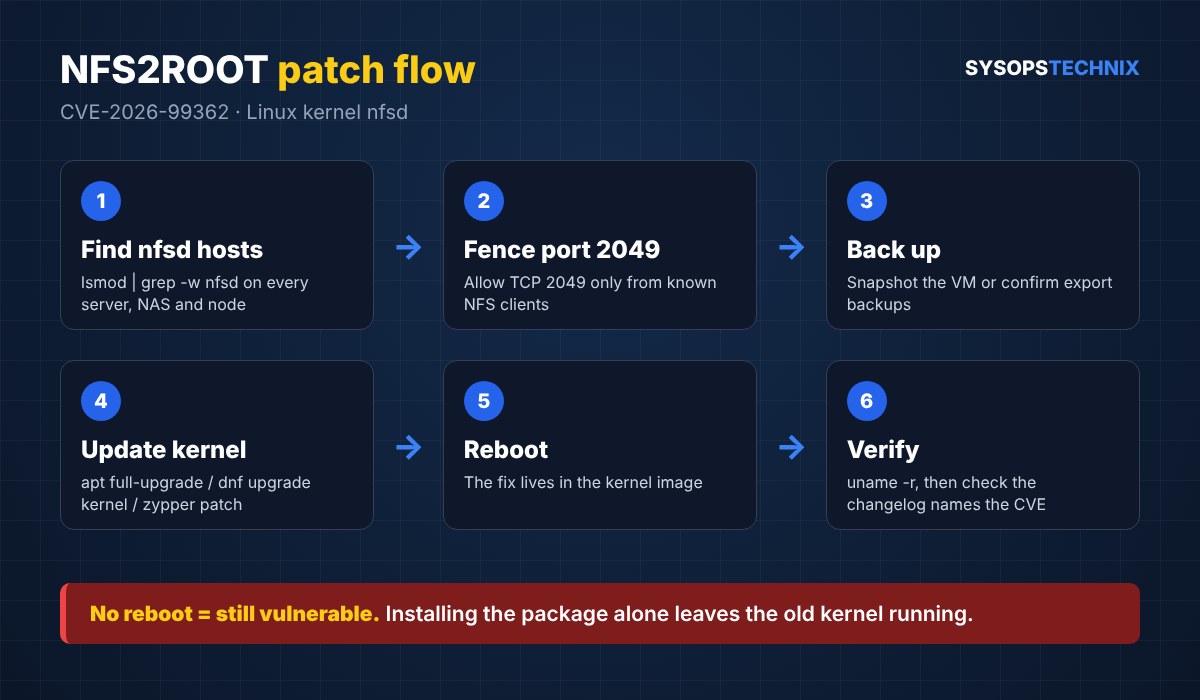
There is no configuration switch that removes the bug; the fix is in the kernel itself. That means a kernel update and a reboot on every affected NFS server. Plan a maintenance window, because NFS clients will hang or error while the server is down.
1. Back up and plan the outage. Snapshot the VM or confirm your backups of the exported data are recent. Tell the teams that mount these shares. If clients use hard mounts, they’ll block until the server is back, which is usually what you want.
2. Install the patched kernel.
Debian and Ubuntu
sudo apt update
sudo apt full-upgrade
# confirm the new kernel package references the CVE
apt changelog linux-image-amd64 2>/dev/null | grep -m1 CVE-2026-99362
RHEL, AlmaLinux, Rocky Linux, Fedora
sudo dnf upgrade --refresh kernel
rpm -q --changelog kernel | grep -m1 CVE-2026-99362
SUSE and openSUSE
sudo zypper refresh
sudo zypper patch
3. Reboot into the new kernel. Live patching services may or may not cover this CVE, so check your livepatch vendor’s notes before you rely on it instead of a reboot.
sudo systemctl reboot
4. Verify. Confirm the running kernel is the patched one and that NFS is serving again.
uname -r
systemctl status nfs-server --no-pager
cat /proc/fs/nfsd/versions
exportfs -v
5. Tidy up. Once you’re confident the new kernel is stable, clear out old kernel packages so a fallback boot can’t land you on a vulnerable build. On Debian, our guide on how to safely remove old kernels walks through it.
Appliances and Kubernetes nodes count too. Storage appliances, hyperconverged nodes and Kubernetes workers that serve NFS through the in-kernel server need the vendor’s kernel update. Don’t assume a “file server” label is the only place nfsd runs: check with lsmod across your fleet.
Temporary mitigations if you can’t patch yet
These buy time. They don’t replace the kernel update, and neither the kernel developers nor the researchers present them as a fix.
Restrict port 2049 to known clients. This is the most effective stopgap. The attacker needs a TCP connection to nfsd, so if only your storage network can reach the port, the attack surface shrinks to hosts you already trust. Replace 10.20.0.0/16 with your NFS client range.
firewalld (RHEL family)
sudo firewall-cmd --permanent --remove-service=nfs
sudo firewall-cmd --permanent --add-rich-rule='rule family="ipv4" source address="10.20.0.0/16" service name="nfs" accept'
sudo firewall-cmd --reload
UFW (Ubuntu)
sudo ufw allow from 10.20.0.0/16 to any port 2049 proto tcp
sudo ufw deny 2049/tcp
In the cloud, tighten the security group or firewall rule for 2049 as well. An NFS server open to 0.0.0.0/0 was a bad idea before NFS2ROOT; now it’s an emergency.
Turn off NFSv4.1 and 4.2. The vulnerable code sits in the NFSv4.1+ session handling, and OpenSec lists disabling these versions as an interim option. Expect side effects: pNFS and some 4.2 features stop working, and clients that mount with vers=4.2 must fall back to 4.0 or 3, so test a client first.
/etc/nfs.conf
sudo systemctl restart nfs-server
cat /proc/fs/nfsd/versions   # should now show -4.1 -4.2
Stop nfsd where it isn’t needed. Plenty of servers have nfs-server enabled from an old project. If nothing mounts from it, switch it off: sudo systemctl disable --now nfs-server. Fewer exposed services is the cheapest hardening there is, and our small business server hardening guide covers more of that thinking.
Signs of compromise on NFS servers
There’s no public exploit yet, and no reported attacks. Still, the attack is valid NFS traffic, so network IDS rules won’t help much. OpenSec’s hunting notes point to host-side clues instead. Treat each as a lead to investigate, not proof:
Kernel warnings and oopses in nfsd paths
sudo journalctl -k --since "2026-11-01" | grep -E 'nfsd4_check_resp_size|nfsd4_|svc_|call_usermodehelper'
sudo dmesg -T | grep -i -E 'nfsd|KASAN|BUG:'
Shells whose parent is a kernel thread (PPID 2)
ps -eo pid,ppid,user,lstart,comm | awk '$2==2 && $NF ~ /^(sh|bash|dash)$/'
Who is talking to nfsd right now
ss -tn state established '( sport = :2049 )'
- A warning from
nfsd4_check_resp_sizeappears on every attempt, successful or not, so it’s the strongest single indicator. - Bursts of short-lived NFSv4.1 sessions from one source in firewall or flow logs.
- Connections to 2049 from addresses that aren’t in your list of NFS clients.
- Unexpected reboots or power-offs of NFS servers (OpenSec’s demo ended by powering the victim off).
If you find a match on an unpatched server, handle it as an incident: isolate the host from everything except your management network, capture memory and logs before rebooting, then rebuild from a known-good image rather than “cleaning” it. A kernel-level root compromise isn’t something you can reliably scrub. Rotate any credentials and keys the host held, and review the exported data for tampering.
NFS2ROOT FAQ
What is NFS2ROOT?
NFS2ROOT is the name OpenSec gave CVE-2026-99362, a heap overflow in the Linux kernel’s NFS server. An unauthenticated attacker who can reach TCP 2049 can trigger it with crafted NFSv4.1 or 4.2 requests and, with a full exploit chain, run code as root.
Is CVE-2026-99362 being exploited in the wild?
Not as far as anyone has reported. As of November 29, 2026 it isn’t in CISA’s Known Exploited Vulnerabilities catalog, and OpenSec has kept its exploit private. The technical details and the fix are public, though, so expect that to change.
Are NFS clients affected?
No. The bug is in the server side (nfsd). A machine that only mounts NFS shares isn’t exposed through this flaw, unless it also exports shares.
Is NFSv3 affected?
The vulnerable path is the NFSv4.1 session reply cache, which NFSv3 and NFSv4.0 don’t use. That’s why disabling 4.1 and 4.2 works as a stopgap. The kernel still needs patching, since most servers have 4.1 and 4.2 on by default.
Do I have to reboot after updating the kernel?
Yes. Installing the package only puts the new kernel on disk. The old, vulnerable kernel keeps running until you reboot, unless your livepatch provider has explicitly shipped a patch for this CVE.
How do I update the Linux kernel on Ubuntu or Debian?
Run sudo apt update and sudo apt full-upgrade, reboot, and check uname -r. On Ubuntu, wait for the USN that lists CVE-2026-99362 before assuming the update covers it.
Sources
- CVE-2026-99362 record (kernel.org CNA)
- NVD: CVE-2026-99362
- OpenSec: NFS2ROOT research write-up
- Upstream fix: nfsd: preflight SEQUENCE replies before accepting a slot
- Debian security tracker and DLA-4942-1
- Ubuntu CVE page
- Red Hat CVE page
- oss-security mailing list post
- Cyber Security News report