
The Azure API Management vulnerability that Microsoft quietly closed on November 19, 2026 is the kind of cloud bug that doesn’t go away when the vendor fixes it. An unknown attacker was already going after secrets stored in APIM Classic instances, and the patch on Microsoft’s side does nothing about keys and tokens that may have walked out the door before it landed.
Norway’s National Security Authority (NSM) tied the activity to attacks on its energy sector, including Equinor and Skagerak Energi. Microsoft’s own advice to customers boils down to one job: find every secret your API Management instances hold and rotate it. If you run APIM on a Classic tier, that job is yours this week, not next quarter.
| Advisory ID | No CVE or public advisory ID; Microsoft notified customers through a non-public advisory |
| Affected product | Azure API Management (APIM) Classic tiers: Developer, Basic, Standard, Premium |
| Not affected | APIM v2 tiers (per Microsoft); NSM also lists Consumption as not vulnerable |
| Fixed | Service-side by Microsoft on Nov 19, 2026; NSM lists patched runtime builds as 0.52.x.31936+ and 0.53.x.31938+ |
| Severity | No CVSS score published |
| Exploited in the wild | Yes, per NSM: an unknown actor actively hunted APIM tokens, secrets and named values |
| CISA KEV | Not listed as of Nov 24, 2026 |
| Workaround | None needed for the access path itself; secret rotation is still required |
| Published | Microsoft identified it Nov 18, 2026; NSM notice Nov 20; rotation guide Nov 21 |
TL;DR: what to do now
- List every API Management instance you own and flag the ones on Developer, Basic, Standard or Premium.
- Assume every secret on those instances is exposed: subscription keys, named values, backend credentials, OAuth/OIDC client secrets, logger connection strings and direct management API keys.
- Rotate at the issuer first, update APIM, test, then revoke the old secret.
- Turn off the legacy direct management API if it’s still enabled.
- Hunt the last 30 days of logs for secret reads, policy edits and unfamiliar subscriptions.
What happened with Azure APIM Classic
The story surfaced through Norway rather than Redmond. Equinor said on November 17 that it had detected a cyber-attack against some of its IT systems; by November 20 it reported the attack stopped, production running normally and no sign that data was stolen or changed. Skagerak Energi reported an attempted attack with no effect on operations. NSM then connected the dots to API Management.
| Date | Event |
|---|---|
| Nov 17, 2026 | Equinor reports an ongoing cyber-attack on certain IT systems |
| Nov 18, 2026 | Microsoft identifies the APIM Classic issue |
| Nov 19, 2026 | Microsoft closes the access path service-side; Skagerak Energi publishes an update on its attempted attack |
| Nov 20, 2026 | NSM publishes its warning and recommended measures; Equinor says the attack has been stopped |
| Nov 21, 2026 | Microsoft publishes its credential rotation guide for API Management |
| Nov 23, 2026 | NSM updates its notice; The Register reports on Microsoft’s non-public customer advisory |
Microsoft hasn’t said how many customers were exposed, and there’s still no CVE. According to the advisory text quoted by The Hacker News and The Register, Microsoft’s investigation found that customers were exposed and that an unauthorized party could have used the issue to reach secrets in Classic instances before the fix. That’s about as direct as Microsoft gets about a cloud-side flaw, and it’s why you shouldn’t treat this as a “they fixed it, we’re fine” moment.
What Microsoft says the flaw was
Microsoft describes the bug as a security issue that could allow unauthorized access to certain management functionality on Classic-tier instances. Exposure depended on configuration: instances that didn’t follow Microsoft’s documented network security guidance, or that stored secrets directly in APIM instead of referencing them from Azure Key Vault, were the ones at risk. Microsoft hasn’t published a root-cause write-up or a weakness class, so anyone telling you exactly which endpoint was abused is guessing.
What we do know is the list of things Microsoft says could have been read:
- Named values, the key/value store that APIM policies reference (often API keys and passwords)
- Client secrets for identity providers and OpenID Connect providers configured for the developer portal
- Subscription keys that your API consumers send with every call
- Tokens used to call the direct management API
Think about what sits behind a typical APIM gateway: backend API keys, database-facing services, partner integrations, Entra ID app registrations. Security researcher Anders Kristiansen makes the point plainly in his analysis: a stolen credential works against whatever service it protects, for as long as it stays valid and with whatever permissions it carries. APIM isn’t the prize. It’s the key ring.
Why the legacy direct management API keeps coming up
Classic-tier instances have an old management endpoint at <name>.management.azure-api.net. It predates Azure Resource Manager, authenticates with a shared access signature built from the instance’s tenant access key, and doesn’t go through Entra ID or Azure RBAC. Microsoft retired it on March 15, 2025 and told customers to disable it, but “retired” doesn’t mean “switched off everywhere.” Kristiansen’s write-up notes that calls to it don’t appear in the ARM Activity log. Neither he nor Microsoft says this endpoint was the exploited path, but its tokens are on Microsoft’s list of exposed items, and there’s no good reason to leave it on in 2026.
Am I affected by the Azure API Management vulnerability?
Run through this list for each instance. Dev and test instances count: people who spoke to The Register pointed out that forgotten non-production APIM deployments are exactly where stale secrets pile up.
Tick everything that applies to you
Any box ticked? Rotate now. Ticks reset when you reload the page.
If you have more than a handful of subscriptions, Azure Resource Graph is quicker than clicking through the portal. This lists every APIM instance you can see, with its tier:
Find all API Management instances and their SKU (Azure CLI)
az graph query -q "resources
| where type =~ 'microsoft.apimanagement/service'
| project name, resourceGroup, subscriptionId, location, sku=tostring(sku.name)" --output table
NSM also published a runtime check. Each gateway exposes an internal status endpoint, and NSM says to read the RuntimeVersion value from it:
Check the gateway runtime build (replace the instance name)
curl -si "https://<your-apim-name>.azure-api.net/internal-status-0123456789abcdef" | grep -i runtimeversion
| Runtime branch | Patched | Still vulnerable |
|---|---|---|
| 0.52.x | Last number 31936 or higher | Below 31936 |
| 0.53.x | Last number 31938 or higher | Below 31938 |
| Other numbering (e.g. 0.53.4608.0, 0.52.4150.0) | Treated as not vulnerable by NSM | n/a |
A patched build only tells you the hole is closed. It says nothing about what was read before November 19, so a “patched” result is not a reason to skip rotation. If your build is still below those numbers, NSM’s advice is to contact Microsoft support directly.
Disclaimer: These steps are general guidance based on the vendor’s published advisory and are provided as-is. Every environment is different: test in a staging environment, take a full backup or snapshot first, and follow the vendor’s official documentation. SysOpsTechnix accepts no responsibility for outages, data loss or other damage resulting from applying these steps. See our Terms of Use.
How to fix it: rotate every APIM secret
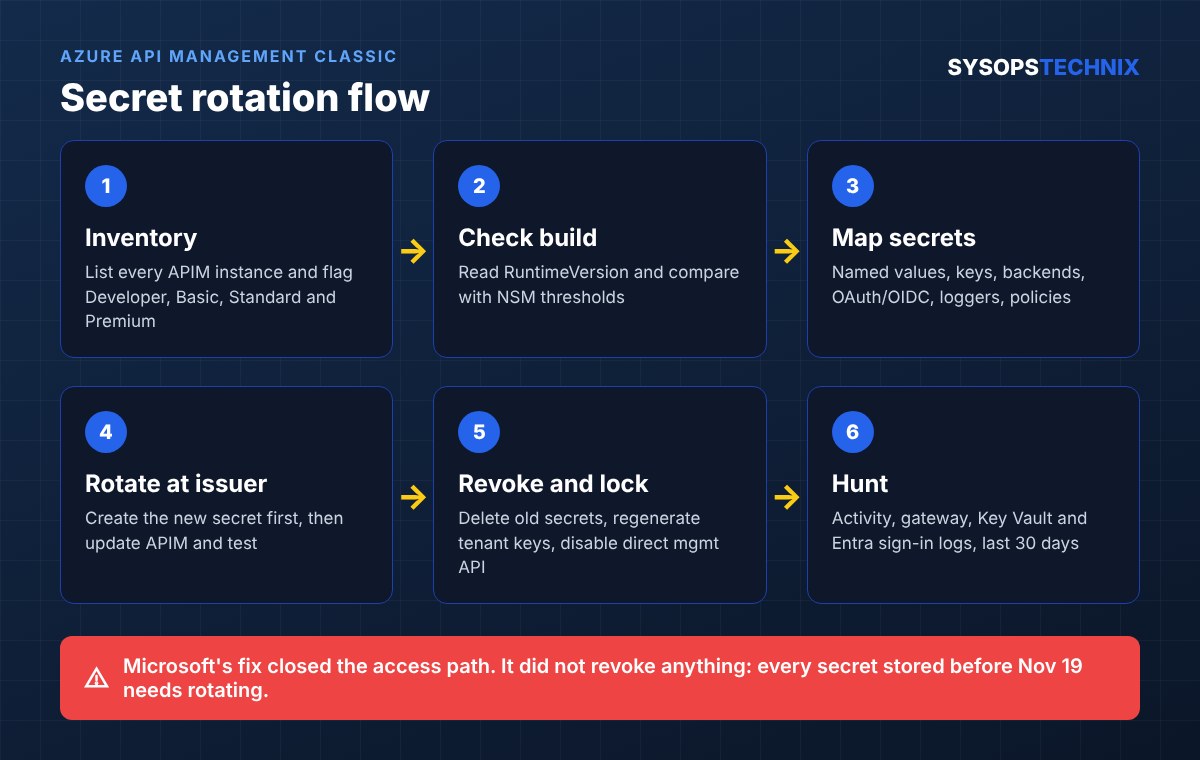
There’s no package to install here. Microsoft fixed the platform; your part is credential hygiene, and it’s tedious. Microsoft’s rotation guide is the reference, and its one rule matters more than any command: updating APIM doesn’t revoke the old secret at its issuer. Create the replacement first, point APIM at it, test, and only then kill the old one. Do it the other way round and you’ll cause your own outage.
Set a shell variable for the instance you’re working on so the commands below stay readable:
Set the management base URL
base="https://management.azure.com/subscriptions/<subscriptionId>/resourceGroups/<rg>/providers/Microsoft.ApiManagement/service/<apimName>"
1. Inventory what each instance holds
Before rotating anything, export a list of what exists. You’ll need it for the change ticket anyway, and it tells you which teams own which secrets.
List named values and whether they come from Key Vault
az apim nv list --resource-group <rg> --service-name <apimName> \
  --query '[].{Id:name, Name:displayName, Secret:secret, KeyVault:!!(keyVault.secretIdentifier)}' -o table
List the other places secrets live
for r in subscriptions backends authorizationServers openidConnectProviders identityProviders loggers; do
  echo "== $r"; az rest --method get --url "$base/$r?api-version=2024-05-01" --query "value[].name" -o tsv
done
Don’t forget policies. Hard-coded keys in global or API-level policy XML are common and easy to miss; Microsoft’s guide shows how to pull the raw policy with format=rawxml. Keep CLI output with secret values out of shared logs and pipeline output.
2. Regenerate subscription keys without breaking clients
Every APIM subscription has a primary and secondary key, which makes a zero-downtime swap possible: move callers to the secondary, regenerate the primary, move them back, then regenerate the secondary.
Regenerate keys for one subscription
az rest --method post --url "$base/subscriptions/<sid>/regeneratePrimaryKey?api-version=2024-05-01"
# after clients have moved back to the new primary key:
az rest --method post --url "$base/subscriptions/<sid>/regenerateSecondaryKey?api-version=2024-05-01"
3. Rotate named values and backend credentials
For Key Vault-backed named values, add a new secret version in Key Vault, then refresh APIM. A versionless secret identifier lets APIM pick up new versions on its own. For plain named values, change the real credential at its source (the backend API, database or SaaS provider) and then update APIM. This is also a good moment to move those plain secrets into Key Vault, since Microsoft lists direct storage in APIM as one of the risk factors.
Refresh a Key Vault-backed named value
az rest --method post --url "$base/namedValues/<namedValueId>/refreshSecret?api-version=2024-05-01"
Update a plain named value with the new credential
az apim nv update --resource-group <rg> --service-name <apimName> \
  --named-value-id <namedValueId> --value "<newValue>"
Backend entities with header credentials, client certificates and logger connection strings (Event Hubs, for example) need the same treatment. Rotate at the source, update APIM, confirm traffic flows, then revoke.
4. Rotate OAuth and OpenID Connect client secrets
If the developer portal signs users in with Entra ID or another identity provider, the client secret on that app registration is on Microsoft’s exposed list. Add a new secret alongside the old one, update APIM under Developer portal > OAuth 2.0 + OpenID Connect (or Identities), republish the portal, test a sign-in, then delete the old secret. If your team already runs Entra ID access reviews, use this as a reason to review who owns those app registrations too.
Add a new secret to the Entra app, then remove the old one
az ad app credential reset --id <appId> --append --display-name "apim-rotation-2026-11"
# after APIM is updated and tested:
az ad app credential delete --id <appId> --key-id <oldKeyId>
5. Regenerate tenant access keys and disable the direct management API
The tenant access keys sign the shared access tokens used by the legacy direct management API. Check that nothing still depends on them (old scripts are the usual culprit), then regenerate both keys. The same API also has a gitAccess key; if anyone ever used the Git configuration feature, regenerate that too.
Regenerate tenant access keys
az rest --method post --url "$base/tenant/access/regeneratePrimaryKey?api-version=2024-05-01"
az rest --method post --url "$base/tenant/access/regenerateSecondaryKey?api-version=2024-05-01"
Then switch the endpoint off: in the Azure portal, open the instance, go to Management API and set Enable Management REST API to No. Repeat for every Classic instance, including dev and test.
6. Verify
Once rotation is done, call a few APIs with the new subscription keys, confirm backends return 200s, check that the developer portal sign-in still works and that logs are still arriving in Event Hubs or Log Analytics. Finally, look for anything you didn’t create: Microsoft’s guide specifically tells customers to review subscriptions, users, policies and backends for unknown entries.
There’s no temporary mitigation to apply instead of all this. Microsoft already closed the access path; the only remaining exposure is credentials that were read before that, and the only fix for a leaked credential is a new one.
Signs your APIM secrets were used
NSM says it’s still unclear how widespread the exploitation was, and Microsoft wants customers to investigate whether their instances were compromised before the fix. Start with the Azure Activity log, which records management-plane operations made through Resource Manager:
KQL: APIM secret reads and config changes in the last 30 days (AzureActivity)
AzureActivity
| where TimeGenerated > ago(30d)
| where ResourceProviderValue =~ "MICROSOFT.APIMANAGEMENT"
| where OperationNameValue has_any ("listSecrets", "listValue", "policies/write",
    "namedValues/write", "identityProviders/write", "users/write", "portalsettings/write")
| summarize Count = count(), First = min(TimeGenerated), Last = max(TimeGenerated)
    by Caller, OperationNameValue, _ResourceId
| order by Last desc
Look for callers you don’t recognize, operations at odd hours, and policy or identity provider changes nobody owns up to. Remember the blind spot: calls through the direct management API don’t show up here.
Then widen the search beyond APIM itself, because that’s where a stolen secret would actually be used:
- Gateway logs (ApiManagementGatewayLogs): new subscription IDs that weren’t active in the previous month, and requests with tracing turned on.
- Key Vault audit logs: bursts of SecretGet or SecretList calls against vaults that APIM references, especially from identities other than APIM’s managed identity.
- Entra ID service principal sign-ins: sign-ins by the app registrations APIM uses, from IP addresses you haven’t seen before.
- Backend systems: authentication with the old keys after you rotated them is a strong signal that someone else has a copy.
Kristiansen’s write-up has fuller hunting queries for each of these tables if you want a starting point. If anything looks wrong, treat it as an incident rather than a config cleanup: preserve logs before retention expires, revoke the affected credentials immediately, check what the backend behind that credential exposed, and involve your incident response provider or Microsoft support. Organizations in Norway are asked to report to NSM.
Azure APIM security FAQ
Is there a CVE for the Azure API Management vulnerability?
Not as of November 24, 2026. Microsoft fixed it on the service side and informed customers through a non-public advisory, and no CVE ID or CVSS score has been published.
Do I need to patch or update API Management myself?
No. Microsoft closed the access path on November 19, 2026 for all Classic instances. What you do need to do is rotate the secrets those instances held, because the fix doesn’t invalidate anything that was already read.
Are APIM v2 and Consumption tiers affected?
Microsoft says only the Classic tiers are affected, not v2. NSM’s runtime check also lists Consumption tier instances as not vulnerable. If you have both Classic and v2 instances, focus rotation on the Classic ones, but shared secrets used in both should still be rotated.
Does storing secrets in Azure Key Vault protect me?
It helps, and Microsoft lists secrets stored directly in APIM as a risk factor. It isn’t a full shield, though: anyone who can edit policies or use request tracing on an instance may still get at values APIM fetches from Key Vault. Rotate Key Vault-backed secrets too.
Which secrets should I rotate first?
Start with whatever grants the most access: backend credentials and named values that reach production data, Entra app secrets with broad API permissions, and tenant access keys. Subscription keys come next. Logger connection strings and low-privilege test keys can follow.
Sources
- NSM: NSM deler tiltak mot sårbarhet i Azure API Management (Nov 20, 2026, updated Nov 23)
- Microsoft Azure Integration Services Blog: Rotating credentials in Azure API Management (Nov 21, 2026)
- Microsoft Learn: Direct management API retirement (March 2025)
- Equinor: Equinor detected cyber attack (Nov 17–20, 2026)
- Skagerak Energi: Oppdatering på forsøk på cyberangrep (Nov 19, 2026)
- Anders Kristiansen: Azure API Management advisory, what to check and how to hunt (Nov 21, 2026)
- The Register: Norway links energy firm cyberattacks to critical Azure API Management flaw (Nov 23, 2026)
- The Hacker News: Microsoft Fixes Azure API Management Classic Flaw as Actor Targets Customer Secrets (Nov 24, 2026)
Looking for more patch guidance? Our previous Security News post covered the Linux KVM vulnerability CVE-2026-99312 and how to check AMD hosts.