

A newly disclosed KVM vulnerability, CVE-2026-99312, lets someone with root inside a virtual machine break out and read or write the host’s physical memory. It only bites on AMD hosts with nested virtualization switched on, but on those hosts it’s about as bad as virtualization bugs get: one tenant’s VM can see every other tenant’s memory, and the host kernel too.
The upstream fix is out, but as of 21 November 2026 Debian, Ubuntu and Red Hat haven’t shipped patched kernels for their stable releases. So for most people running their own KVM, Proxmox or libvirt hosts, the practical fix today is turning nested virtualization off. Here’s how to tell whether you need to, and how to do it without surprises.
| CVE | CVE-2026-99312 (Linux kernel, KVM on AMD / SVM) |
| Affected | AMD x86 hosts running KVM with nested virtualization enabled (the kvm_amd default); code present since 2022 (6.1, backported to 5.15.81 and 6.0.11). Intel hosts are not affected. |
| Fixed versions | Upstream 7.3.5, 6.18.64, 6.12.118 and 7.4-rc2; no upstream fix yet for 6.6, 6.1 or 5.15 (as of 21 Nov 2026) |
| Distro packages | No fixed kernel for Debian 12/13, Ubuntu 22.04/24.04/26.04 or RHEL 9/10 yet (Debian unstable has 7.3.5-1); RHEL 8 and Ubuntu 20.04 not affected |
| Severity | CVSS 3.1 8.8 (kernel CNA); Red Hat 7.8; Ubuntu priority High |
| Exploited in the wild | No known exploitation as of 21 Nov 2026; no public exploit code |
| CISA KEV | Not listed as of 21 Nov 2026 |
| Workaround | Yes: set kvm_amd nested=0 and reboot the host |
| Published | 18 Nov 2026 |
What to do now
1. Check your hosts: AMD CPU and /sys/module/kvm_amd/parameters/nested showing 1 or Y means you’re exposed.
2. Turn nested virtualization off (options kvm_amd nested=0) and reboot in a maintenance window, unless a guest genuinely needs it.
3. Install the fixed host kernel as soon as your distro ships it, then reboot again.
4. Updating guest VMs does nothing. This is fixed on the host only.
5. On a public cloud? It’s your provider’s job; DigitalOcean has already patched.
What Happened
| Date (2026) | Event |
|---|---|
| 21 Oct | Oren Yomtov of Terra Security reports the bug to the KVM maintainers, via DigitalOcean’s bug bounty program. |
| 2 Nov | The fix is merged into mainline; it first appears in 7.4-rc2 on 9 November. |
| 17 Nov | Fixed stable kernels ship: 7.3.5, 6.18.64 and 6.12.118. |
| 18 Nov | The CVE is published and Terra releases its technical write-up. |
| 19 Nov | DigitalOcean says it has live-patched its fleet and Droplet customers don’t need to do anything. |
The bug itself has been sitting in the kernel for just under four years. It was introduced by a 2022 fix for a different KVM issue (CVE-2022-3344), which is a good reminder that security patches can carry their own bugs.
How the KVM Vulnerability Works
Nested virtualization lets a VM run its own hypervisor, so you can run VMs inside VMs. On AMD, KVM keeps track of a nested page table pointer for the outer VM. When the inner (nested) guest receives an INIT signal, a CPU reset, KVM is supposed to restore that pointer. It doesn’t. The pointer keeps referring to a page KVM has already freed, and once the kernel hands that page to something else, the hardware happily walks whatever is there now.
Terra showed that a guest with root can use this to forge page-table entries that map any host physical page. On a DigitalOcean host they mapped and read about 127 GB of host RAM. On their own AMD server they went further and wrote data into live host kernel memory. That’s a VM escape in every sense that matters: read anything on the host, and write to it.
- You need all three to be exposed: an AMD CPU, KVM with nested virtualization enabled, and an attacker who controls a guest (root inside a VM).
- Nested is on by default for
kvm_amd, so many hosts are exposed without anyone having made a conscious choice. - Not affected: Intel hosts, AMD hosts with nested turned off, and RHEL 8 / Ubuntu 20.04 kernels (the vulnerable code isn’t there).
- Network access alone isn’t enough. The attacker has to already be inside a VM on that host, which is exactly the situation on any multi-tenant host, VPS provider or shared lab.
Severity ratings differ a bit, which is normal for kernel CVEs. The kernel’s own CNA scores it 8.8, Red Hat 7.8 and Ubuntu rates it High. I’d treat it as urgent on any host where people you don’t fully trust have root in a VM, and as routine maintenance on a single-user homelab box.
Am I Affected? Check Your KVM Hosts
Run these on the host, not inside a VM. If you only rent VMs from a cloud provider, there’s nothing for you to check; it’s on them.
Am I affected? Tick everything that applies to you
All of the first three ticked? The host is vulnerable; turn nested off now. Ticks reset when you reload the page.
Quick check on the host
grep -m1 vendor_id /proc/cpuinfo
cat /sys/module/kvm_amd/parameters/nested
uname -r
Example output on an exposed host
vendor_id	: AuthenticAMD
1
6.12.117-amd64
If the kvm_amd path doesn’t exist, the module isn’t loaded and the host isn’t running KVM on AMD right now.
| Platform | Status (21 Nov 2026) |
|---|---|
| Upstream kernel | Fixed in 7.3.5, 6.18.64, 6.12.118, 7.4-rc2; 6.6, 6.1 and 5.15 not yet fixed |
| Debian 12 bookworm / 13 trixie | Vulnerable (6.1.192-2 / 6.12.117-1); fixed only in unstable (7.3.5-1) |
| Ubuntu 22.04, 24.04, 26.04, 26.10 | Vulnerable, no fixed package yet (priority High); 20.04 not affected |
| RHEL 9 / 10 and rebuilds | Affected, no errata yet; RHEL 8 and 7 not affected |
| DigitalOcean | Live-patched; no customer action needed |
Disclaimer: These steps are general guidance based on the published kernel, distribution and vendor advisories and are provided as-is. Every environment is different: test in a staging environment, take a full backup or snapshot first, and follow your distribution’s official documentation. SysOpsTechnix accepts no responsibility for outages, data loss or other damage resulting from applying these steps. See our Terms of Use.
How to Fix the KVM Vulnerability
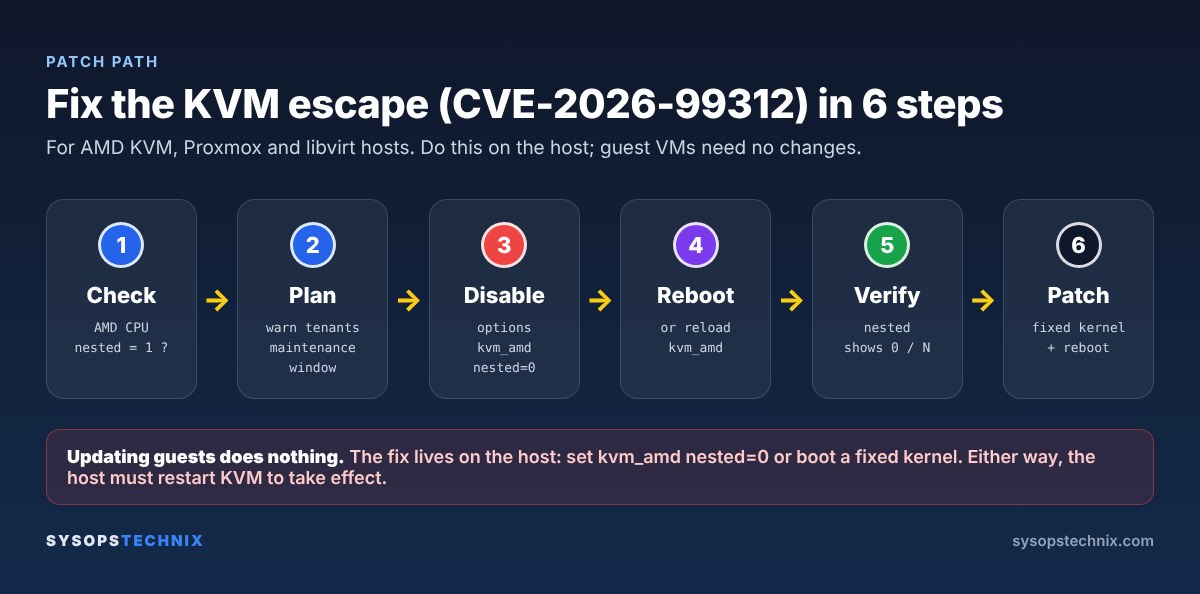
Until your distribution ships a fixed kernel, disabling nested virtualization is the fix. It’s also the faster option on hosts where nobody actually runs VMs inside VMs.
Check before you switch it off. Disabling nested virtualization breaks guests that run their own hypervisor, Android emulators or Docker Desktop inside a VM. Ask your users or tenants first, and plan a maintenance window: the setting can’t change while VMs are running.
Step 1: Find any existing nested setting
grep -RHn '^[^#]*kvm_amd.*nested' /etc/modprobe.d/ /run/modprobe.d/ /usr/lib/modprobe.d/ /lib/modprobe.d/ 2>/dev/null
grep -o 'kvm_amd.nested=[^ ]*' /proc/cmdline
The first command shows any config file that sets nested; the second shows whether it’s forced on from the kernel command line.
Step 2: Set nested=0
If Step 1 found a file with nested=1, change it in place (adjust the filename)
sudo sed -i '/kvm_amd/s/nested=1/nested=0/' /etc/modprobe.d/kvm.conf
If nothing was found, add the option
echo "options kvm_amd nested=0" | sudo tee -a /etc/modprobe.d/kvm.conf
modprobe -c | grep '^options kvm_amd'
Every line from the last command should end in nested=0. If Step 1 showed kvm_amd.nested=1 on the kernel command line, remove it from GRUB_CMDLINE_LINUX and GRUB_CMDLINE_LINUX_DEFAULT in /etc/default/grub, then run sudo update-grub (Debian, Ubuntu, Proxmox) or sudo grubby --update-kernel=ALL --remove-args="kvm_amd.nested=1" (RHEL, Alma, Rocky).
Step 3: Apply it
Shut down or migrate the VMs, then reboot the host. If you can’t reboot but can stop every VM, reloading the module also works:
sudo modprobe -r kvm_amd && sudo modprobe kvm_amd
Step 4: Verify
cat /sys/module/kvm_amd/parameters/nested
You want 0 or N. Repeat on every AMD host, and add the setting to your host build templates or config management so new hosts don’t come up exposed.
Step 5: Install the fixed kernel when it lands
Keep watching your distribution’s tracker for CVE-2026-99312. When a fixed kernel appears, install it and reboot; a kernel update does nothing until the host boots into it.
Ubuntu, Debian and Proxmox VE
sudo apt update && sudo apt full-upgrade
apt changelog linux-image-$(uname -r) 2>/dev/null | grep -c CVE-2026-99312
sudo reboot
RHEL, AlmaLinux and Rocky Linux
sudo dnf check-update kernel
sudo dnf update kernel
sudo reboot
If your vendor offers kernel live patching (Ubuntu Livepatch, kpatch and similar), check whether it covers this CVE; DigitalOcean used a live patch to fix its fleet without rebooting customers. Once you’ve booted a fixed kernel, you can turn nested virtualization back on if you need it. Old kernels pile up quickly after a few of these updates, so it’s worth knowing how to safely remove old kernels on Debian.
Signs of Compromise
There’s no published detection guidance for this one, and an attack that only reads memory may leave nothing behind. That’s an honest limitation, not a reason to skip the basics:
- Know which hosts were exposed. Any AMD host with nested on and untrusted guests should be treated as possibly read by a guest until it’s mitigated.
- Look for host kernel instability around KVM: oopses, unexpected reboots or memory errors in
journalctl -kare worth a closer look. - Review who has root in which VMs, especially on shared or customer-facing hosts.
- Rotate secrets that lived in host memory (other guests’ data, keys held by host services) if you have reason to think an untrusted guest targeted the host.
journalctl -k --since "30 days ago" | grep -iE 'kvm|svm|bug:|oops' | tail -30
For the bigger picture on locking down virtualization management, the steps in my vCenter zero-day guide (restricting management access, watching for unexpected admin accounts) apply to any hypervisor platform.
KVM Vulnerability FAQ
Is CVE-2026-99312 being exploited?
No exploitation has been reported as of 21 November 2026, no public exploit code exists, and it isn’t on CISA’s Known Exploited Vulnerabilities list. The researchers’ memory-write test was on their own hardware.
Are Intel KVM hosts affected?
No. The bug is in KVM’s AMD (SVM) nested virtualization code. Intel hosts and AMD hosts with nested virtualization disabled are not affected.
Which kernel versions fix the KVM vulnerability?
Upstream 7.3.5, 6.18.64, 6.12.118 and 7.4-rc2. The 6.6, 6.1 and 5.15 stable lines had no fix yet as of 21 November 2026, and distribution kernels need their own updates.
Do I need to update my guest VMs?
No. The bug is on the host. Updating guests changes nothing; the host kernel or the kvm_amd nested setting is what matters.
I rent a VPS. What should I do?
Nothing on your side. It’s your provider’s host to fix. DigitalOcean has already live-patched, and many providers weren’t exposed because they never enabled nested virtualization on AMD. If you’re unsure, ask your provider.
Is Proxmox VE affected?
Proxmox uses its own Debian-based kernel and KVM, so AMD Proxmox hosts with nested virtualization enabled should be treated as exposed until Proxmox ships a fixed kernel. The nested=0 steps above work the same way on Proxmox.
Running into problems turning nested off, or found something odd on a host? Leave a comment and I’ll help where I can.
Sources
- Terra Security: KVM guest-to-host escape write-up
- DigitalOcean: CVE-2026-99312 patch notice
- Ubuntu: CVE-2026-99312, Debian security tracker and Red Hat: CVE-2026-99312
- VirtFusion operator guide for CVE-2026-99312
- The Hacker News: New Linux KVM flaw